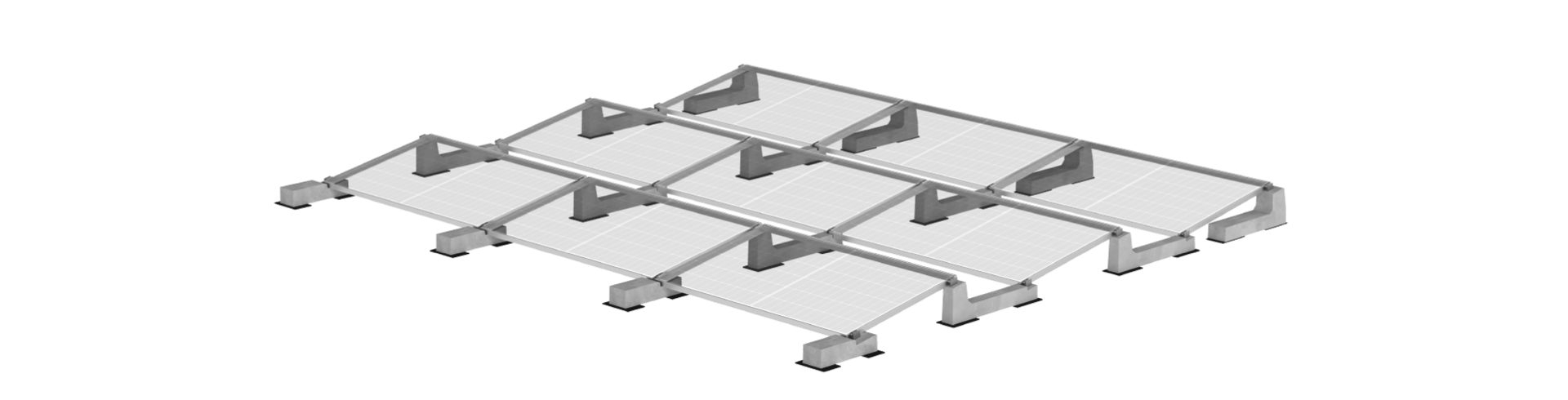
Why a Non-Penetrating Racking System Matters
on Italian Flat Roofs
In Italy, flat-roof photovoltaic projects often come with a
familiar concern: how to secure panels without compromising the waterproof membrane. A
non-penetrating racking system answers this directly by avoiding roof drilling and using
ballast-based stability instead. For installers, that translates into fewer on-site risks,
faster workflows, and less time spent managing sealing details that can lead to future leaks.
For designers and engineers, it means clearer load paths and a solution that supports wind and
structural checks without adding unnecessary complexity. The right non-penetrating approach is
built around prefabricated concrete ballast blocks that act as both structure and weight,
reducing the number of separate components to assemble on the roof. That simplicity is a major
advantage when working on logistics-heavy sites, tight schedules, or large commercial rooftops.
It also supports cleaner project planning: fewer penetrations mean fewer unknowns, less rework,
and smoother handovers. When you need a flat roof solar mounting system that prioritizes safety,
speed, and membrane protection, non-penetrating racking is one of the most practical choices for
the Italian market.
Key Benefits for Installers: Speed,
Simplicity, and Fewer Site Headaches
Installers choose a non-penetrating racking system mainly for one
reason: it helps them install more kilowatts per day with fewer problems. A ballast PV mounting
structure minimizes parts, limits roof preparation, and simplifies alignment, so crews can move
quickly from layout to placement. Because there are no roof anchors to drill, you reduce dust,
noise, and the chance of hitting hidden layers or services—issues that can stall a job and
increase liability. In addition, concrete ballast solutions are designed to be intuitive:
positioning, tilt selection, and row spacing can be standardized across the project, making
training and quality control easier. The result is a more predictable installation process,
especially valuable for flat roof solar installations on warehouses, industrial buildings, and
large commercial properties across Italy. With a non-penetrating system, you also protect your
reputation: fewer waterproofing disputes and fewer call-backs related to roof integrity. If your
priority is a reliable, quick-to-deploy flat roof racking solution that keeps the site moving,
ballast-based non-penetrating mounting is a strong match.
Technical Support and Design Confidence for
Professionals
For engineers, technical offices, and distributors, performance is
not only about speed—it is about providing a solution that is easy to specify, justify, and
deliver. A non-penetrating racking system supported by solid technical documentation makes wind
calculations, roof load verification, and system sizing more straightforward. Concrete ballast
designs can be optimized by layout, exposure, and module configuration, helping reduce
uncertainty during the design phase and lowering overall project risk. This is where a
technical-partner approach makes the difference: you want dependable data, responsive assistance
during dimensioning, and guidance that follows the project through execution—without forcing you
to piece together fragmented components from multiple sources. For distributors, a recognizable,
in-demand flat roof PV solution is also easier to explain and stock because it answers a clear
market need: fast, safe installations without roof penetrations. If you are planning flat-roof
solar in Italy and need a non-penetrating racking system that is practical on site and
defensible on paper, choose a ballast-based solution engineered for reliability, simplicity, and
long-term durability.